Signals in Cold Water: Brook Trout and a Warming World
By Snigdhodeb Dutta, Ph.D student under the supervision of Dylan Fraser at Concordia University.
Cold water up to my knees, a thermometer dangling from my wrist, and brook trout darting between shadows of submerged cobbles—this is where climate change becomes tangible. Not in global graphs or policy debates, but in small, forested streams where a fish that once thrived is now quietly struggling.
Brook trout (Salvelinus fontinalis) are more than just a beautiful freshwater fish. They are one of the clearest biological signals we have that our streams are changing.
A fish that demands the cold
Brook trout are native to eastern North America and are widely recognized by freshwater ecologists as a cold-water specialist. Based on decades of fisheries research, they perform best in cool, well-oxygenated streams fed by groundwater or shaded by intact forest canopies. When water warms beyond what their physiology can tolerate, their growth slows, reproduction suffers, and survival declines.
I cannot confirm a single universal “critical temperature,” because tolerance varies across populations and environmental conditions. However, there is a broad scientific consensus that even modest, sustained warming can place brook trout populations under stress, especially when combined with low summer flows or reduced oxygen availability.
This sensitivity is precisely what makes them valuable not just as a species of interest, but as an ecological warning signal.
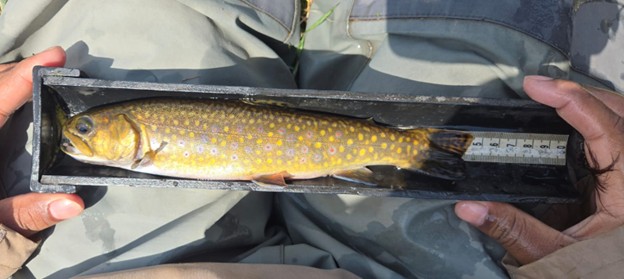
Pic 1 - A living thermometer for our streams.
Reading the stream’s pulse Across Space and Time
In my research, I examine brook trout populations across a gradient of stream types, from cold, groundwater-influenced systems to streams that depend largely on rainfall. Although these streams can appear similar at first glance, they differ markedly in their capacity to buffer temperature extremes and hydrological variability—that is, some streams remain cool and maintain steady flows, whereas others warm quickly and exhibit large fluctuations in water levels.
Rather than relying on single surveys, I work with long-term datasets that integrate fish abundance records with stream temperature, flow conditions, and landscape characteristics such as forest cover. This time-series perspective allows patterns to emerge—revealing how trout populations respond not just to individual warm summers, but to sustained warming, altered precipitation, and differences in hydrological stability.
In cooler, groundwater-influenced streams, trout often persist even during warm summers. In contrast, in rainfall-dependent streams, populations fluctuate more dramatically, sometimes declining after years marked by higher temperatures or altered precipitation patterns.
I cannot attribute every observed decline to climate change alone. Habitat fragmentation, historical land use, and local hydrology all play roles. Still, when long-term warming trends align with repeated population stress across regions, the signal becomes difficult to ignore.
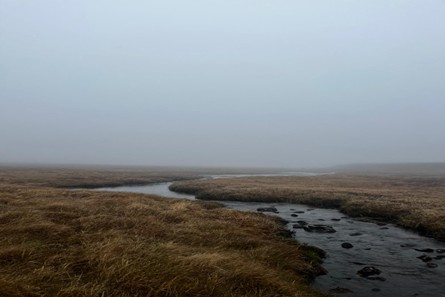
Pic 2 - A lifeline in the landscape. A cold-water refuge, where trout cling to survival.
When Fish Respond Before We Do: Early Signals of Change
The phrase “canary in the coal mine” refers to an early warning system, an organism that responds to danger before humans feel its full effects. Brook trout serve a similar role in freshwater ecosystems.
They respond quickly to:
- rising stream temperatures
- reduced summer flows
- loss of streamside tree cover
- altered seasonal timing of precipitation
Because they sit near the top of stream food webs, their decline often reflects broader ecological disruption, affecting aquatic insects, nutrient cycling, and even terrestrial species that rely on streams.
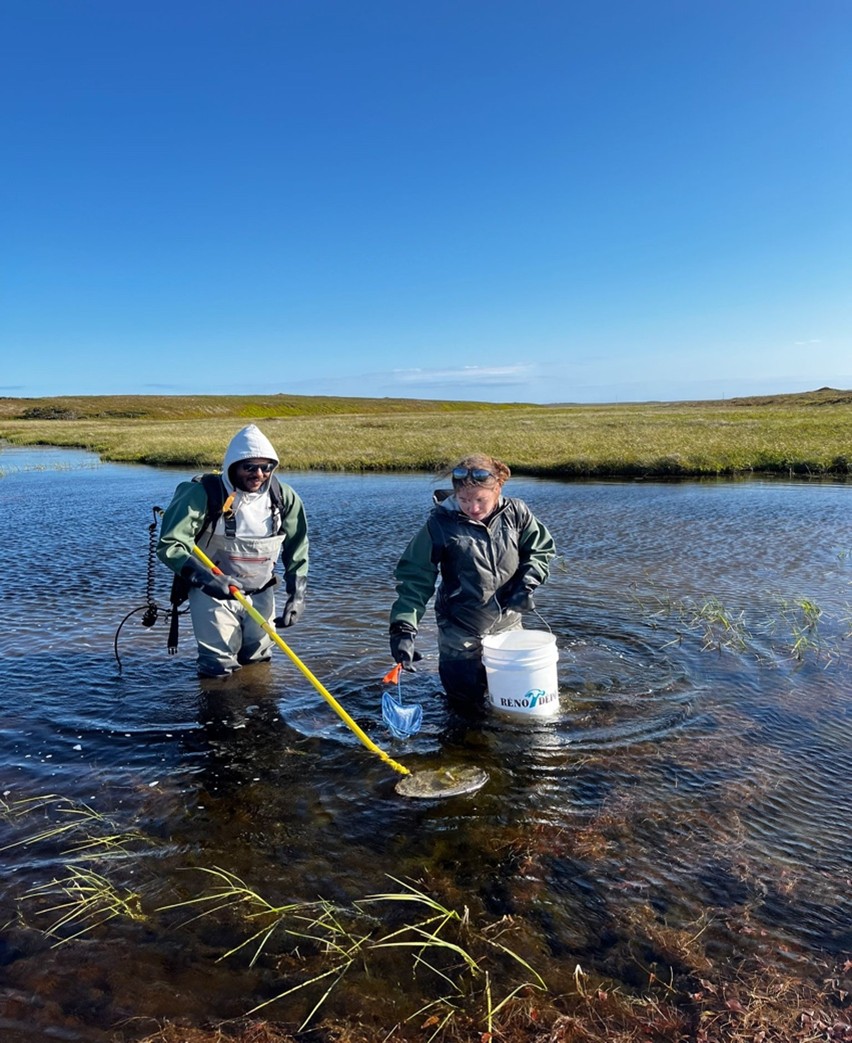
Pic 3- The science in the stream: revealing what the water holds.
A quiet message, if we choose to listen
Standing in a stream, watching brook trout slip beneath a root tangle, it is easy to think of them as resilient. And they are to a point. But resilience is not invincibility.
Based on my work’s available ecological evidence, brook trout are telling us something important: many streams are approaching thermal and hydrological conditions that push cold-water ecosystems to their limits. These changes may appear subtle year to year, but over time, they accumulate.
The trout do not shout. They simply disappear.
If we pay attention to stream temperatures, hydrology, and the fish themselves, we still have the opportunity to protect refuges, restore riverbank cover, and manage watersheds in ways that soften the impacts of a warming world.
Brook trout have been warning us for decades. The question is no longer whether they are signalling change—but whether we are ready to respond.
Suivre ce lien pour consulter d'autres blogues.
Mis en ligne en mars 2026