Winter’s Secret Superfood: How Zooplankton Sustain Arctic Food Webs
By Thanuri Kasthuri Arachchi, Ph.D student under the supervision of Milla Rautio at Université du Québec à Chicoutimi and Andrea Bertolo (UQTR).
“The rapid changes in the environment are prompting us to reconsider our focus on the Far North. While large polar mammals often capture our attention, there's a vital community of microscopic organisms that forms the foundation of life under water.”
- Arctic researcher Warwick Vincent -
When we think about Arctic food webs, large animals like fishes, seals, or polar bears often come to mind. But beneath the thick layer of ice, a much smaller and often overlooked group of organisms plays a powerful role in sustaining life, especially throughout the long, cold and dark winter: zooplankton.
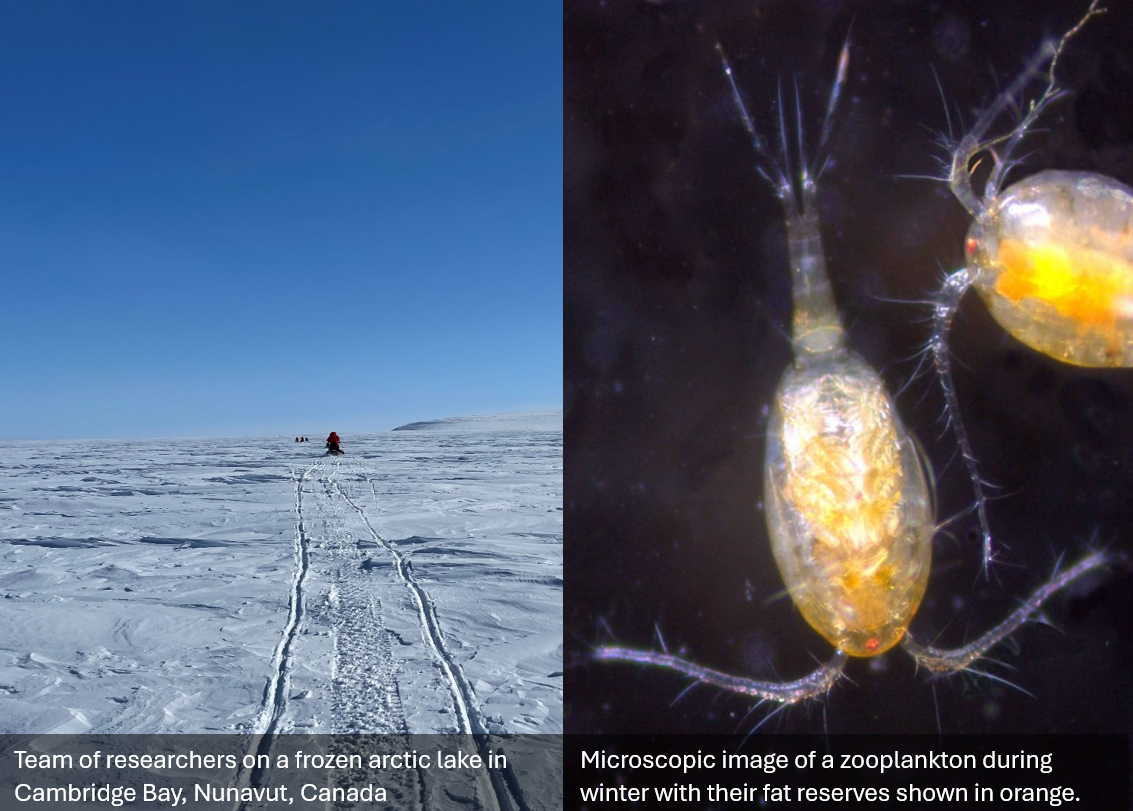
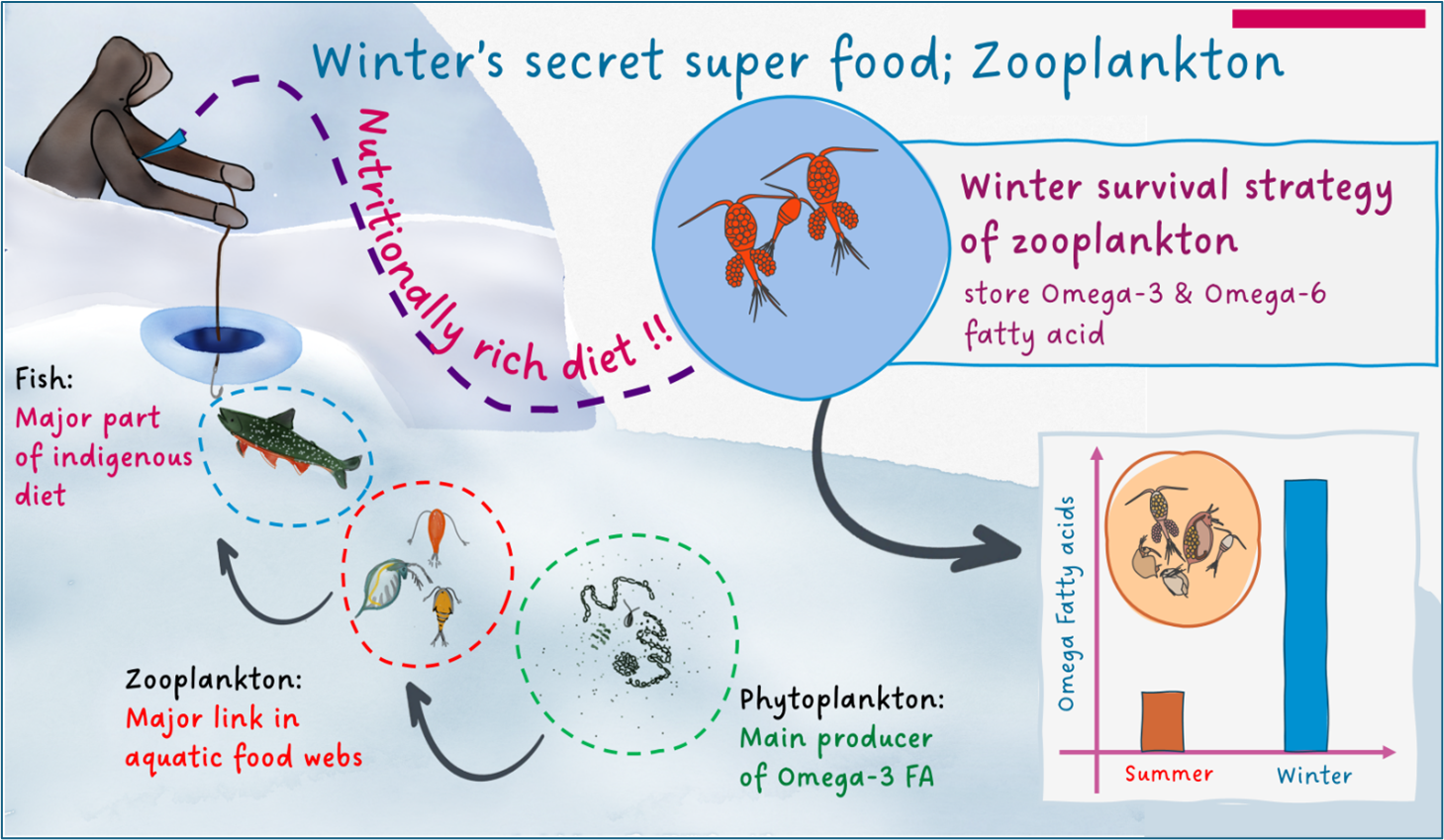
These microscopic organisms are suspended in lakes and oceans. Though tiny, they graze over microscopic plants called phytoplankton, which makes them one of the major primary consumer groups in Arctic lake ecosystems. This allows them to play a key role in transferring nutrients up the food web towards the larger-bodied animals such as fish and then ultimately human.
A source of good fats
Omega-3 and omega-6 are nutrients that are known as “good fats”, and they are essential for growth, reproduction and overall physiological health of all organisms, including humans. Even though zooplankton are most abundant in the summer, surprisingly their winter communities are often more nutritionally rich with these omega-3 and omega-6 fatty acids. Recent research has revealed that before winter, zooplankton store large amounts of omega-3 and omega-6 fatty acids. These good fats support them to survive through the harsh winter conditions. They become a major source of energy for winter-active organisms during the cold season in Arctic and sub-Arctic lakes, when food becomes scarce, temperatures are low, and ice cover limits productivity.
By supporting the winter-active fish populations with high nutritional value throughout winter, zooplankton act as a critical link between aquatic ecosystems and human well-being. This is a good reason to call them the “winter’s secret superfood”. The word “secret” in their title, represents how remarkable an organism invisible to the naked eye can help keep an entire food web afloat, by ensuring that essential nutrients travel from ice-covered lakes all the way to our plates. Therefore, understanding the ecological and nutritional role of zooplankton is not just an academic exercise, but it has real implications for human health and food security in the Arctic.
Climate change and a fragile balance
But the Arctic is warming faster than any other region on Earth. Winters are becoming shorter and warmer. These changes could disrupt the sensitive seasonal patterns and alter the fat storage capacities in zooplankton. If the nutritional quality of winter zooplankton declines, the effects could ripple through fish populations and ultimately impact human health.
This makes studying changing winter conditions and the role of zooplankton in aquatic food webs more important than ever. Zooplankton may be small, but their role is immense. By improving our understanding of how environmental change affects their nutritional quality, research can help predict future impacts on Arctic food webs, guide ecosystem monitoring programs, and inform conservation and management strategies aimed at protecting lake productivity and fish populations. Such knowledge can support evidence-based decisions to mitigate climate change impacts, preserve ecosystem resilience, and safeguard food resources for northern communities. Protecting and understanding these microscopic organisms is therefore a crucial step toward sustaining both ecosystems and the people who depend on them in a rapidly changing world.
References :
- Arts, M. T., Ackman, R. G., & Holub, B. J. (2001). " Essential fatty acids" in aquatic ecosystems: a crucial link between diet and human health and evolution. Canadian Journal of Fisheries and Aquatic Sciences, 58(1), 122-137.
- Grosbois, G., Mariash, H., Schneider, T., & Rautio, M. (2017). Under-ice availability of phytoplankton lipids is key to freshwater zooplankton winter survival. Scientific Reports, 7(1), 11543.
- Grosbois, G., Power, M., Evans, M., Koehler, G., & Rautio, M. (2022). Content, composition, and transfer of polyunsaturated fatty acids in an Arctic lake food web. Ecosphere, 13(1), e03881.
Suivre ce lien pour consulter d'autres blogues.
Mis en ligne en mars 2026